
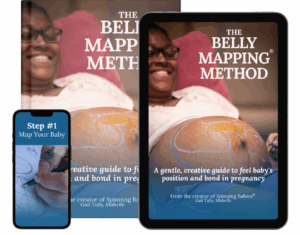
What is the Belly Mapping® Method?
A beautifully illustrated guide designed for parents and professionals alike. Inside, you’ll learn step-by-step how to find your baby’s position and what it means for labor. Enjoy creative games and insights, making pregnancy more engaging. Motivate your birth preparation. The Belly Mapping® Method book is an invitation to celebrate your baby, nurture connection, and bring more awareness and ease to your journey.
What You’ll Learn
Playful awareness and gentle touch can bring you closer to your baby while preparing for birth. Open the pages to Belly Mapping® Method and you’ll find:
- A trusted “companion” for your pregnancy
- How to feel your baby in the womb and create a map to see your baby’s position
- Prenatal bonding activities to deepen the connection with your baby
- Enjoyable activities like belly painting, games, and mindful conversation that celebrate your parenting in pregnancy
- How your baby’s position influences labor and what you can do to support a physiological birth
- Photos, drawings, and charts to help you create a keepsake for this pregnancy
Want some help with your Belly Mapping®?
Spinning Babies® Certified Parent Educators are licensed to teach the Belly Mapping® Method in person. Find a Certified Parent Educator near you here.
Belly Mapping® Certification
If you’re interested in hosting a Belly Mapping® Method salon, join the waiting list for our upcoming Belly Mapping® Method Certification.
FAQs
What is The Belly Mapping® Method?
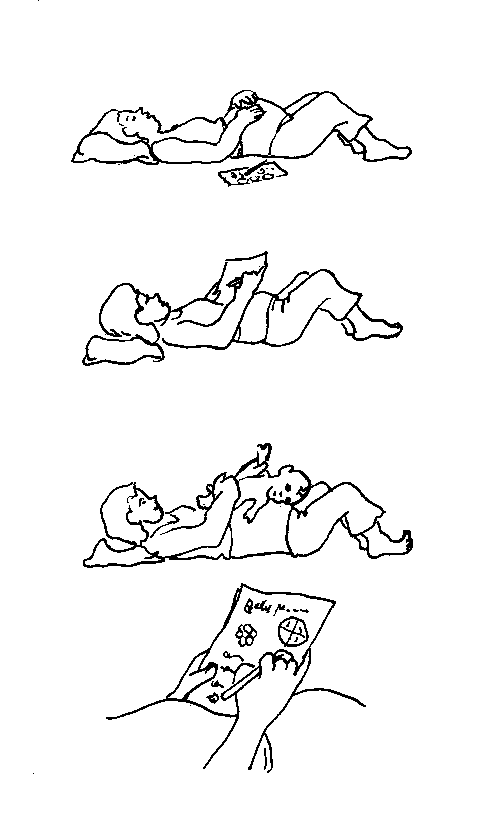
The Belly Mapping® Method is a three-step process for you to gently feel your belly and discover how your baby is lying inside your womb.
When can I start The Belly Mapping® Method?
You can begin anytime in the third trimester (after 28 weeks), though some parents begin in the second trimester. The further along you are, the easier it is to feel details of your baby.
Is it safe for me and my baby?
Yes. Gentle touch using the pads of your fingers is safe and often enjoyable for your baby. Avoid poking or pressing hard. If you feel pain, stop and adjust your pressure.
Is The Belly Mapping® Method accurate?
The Belly Mapping® Method helps parents estimate their baby’s position, but it is not a diagnosis. Accuracy can vary based on gestation, fluid levels, baby’s size, and other factors. Repeating the process can improve accuracy.
How is The Belly Mapping® Method different from an ultrasound?
Ultrasound provides a two-dimensional image, while Belly Mapping® allows you to feel your baby’s three-dimensional form. Though it may not always be as precise as ultrasound, Belly Mapping® offers sensory connection, bonding, and playful interaction. Many parents find their estimations are later validated by ultrasound.
Do I need to be lying down?
Yes. Belly Mapping® works best when you are reclining or lying down with your belly relaxed. For comfort, recline on pillows with a thick pillow under your knees.
What will I actually feel?
What you feel depends on your body and your baby. Common examples include:
• Big, firm areas = baby’s back or bum
• Strong kicks = feet
• Smaller wiggles = hands
• Smooth bulge at the top or bottom = head or buttocks
What if I can’t figure it out?
It’s normal to feel a little challenged or confused at first. Your baby may be behind the placenta or turned to the side. Try again another time, ask your provider for guidance, or repeat the steps with a helper.
Why does baby’s position matter for birth?
The way a baby enters the pelvis can make labor smoother or more challenging. Knowing your baby’s position helps you and your providers choose birth positions and comfort measures that support labor progress.
Can baby’s position change at any time before or during labor?
Yes. Positions can change, even during labor. The Belly Mapping® Method empowers parents to recognize changes and understand how position may affect labor.
Can the Belly Mapping® Method help if my baby is breech?
Yes. It can help you recognize a breech position earlier, giving you time to explore body-balancing activities and discuss options with your provider.
How does The Belly Mapping® Method support bonding?
The Belly Mapping® Method encourages touch, imagination, and playful connection. Many parents enjoy drawing or painting their baby’s position on their belly as a joyful keepsake.
Reviews
The Basics of the Belly Mapping®️ Method
Fetal positioning has a crucial impact on pregnancy comfort and ease in labor and birth.
“Belly Mapping®: Using kicks and wiggles to predict posterior labor” appeared in Vol. 12 Issue 4 (Fall 2004) International Doula, a quarterly publication of DONA International (previously Doulas of North America). This was the first published material on Belly Mapping®.
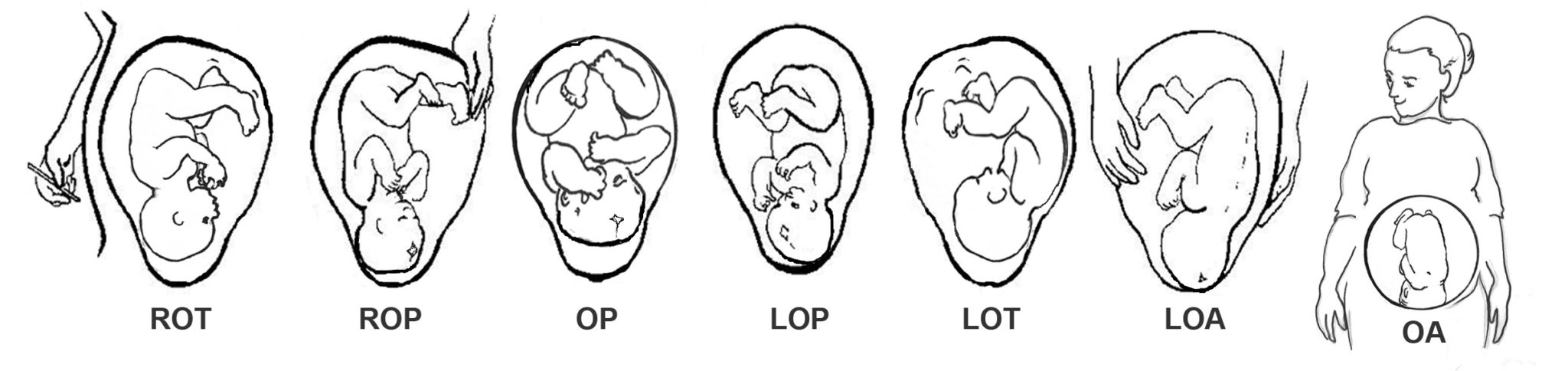
Baby Positions
Click on a SpinningBabies.com description to find out more about the many fetal positions and related topics.
- Anterior
- Posterior
- Breech
- After Baby Turns
- Head Down is Not Enough
- Sideways/Transverse
- Asynclitism
- Other Fetal Positions
- OP Truths & Myths
- Anterior Placenta
- Body Balancing
What to do if someone thinks baby’s position isn’t ideal
The Belly Mapping® Method can be a pleasant bonding experience for the family. You may increase your pleasure by allowing your exploration of your baby’s contours be imbued with love and acceptance. Judging whether a position is good or bad is a thought process, not an invitation to bonding. So, bring a breath of compassion and show up with an open heart and open hands.
Fears about posterior fetal positioning are increased by thinking that nothing can be done. Simple techniques taught in the Spinning Babies® Birth Preparation Online Course or viewed on their streaming video, Parent Class, help reassure all of us that support is available to help baby turn through the pelvis in the birth process, if not before.
Other Spinning Babies® Resources
- Find a Spinning Babies® Certified Parent Educator to take you through our concepts and activities in-person and online
- Stretch each day with Sarah Longacre on the Spinning Babies®/Blooma® Daily Essentials streaming video
- Get bodywork from a Spinning Babies® Aware Practitioner for your pregnancy or even during your birth!
References
- Abbasmofrad, H. (2024). The relationship between emotional creativity and pregnancy anxiety in five to eight months pregnant women. Journal of Modern Psychology, 4(2), 19-26.https://doi.org/10.22034/jmp.2024.432708.1084
- Ahmad, A., et al. (2014). Association between fetal position at onset of labor and mode of delivery: a prospective cohort study. Ultrasound in Obstetrics & Gynecology, 43(2), 176-182.
- Berkeley, S. C., & Stern, D. M. (1941). Pictorial midwifery: An atlas of midwifery for pupil midwives. 4th ed, Baillière, Tindall and Cox.
- Eide, B., et al. (2024). Associations between fetal position at delivery and duration of active phase of labor. Acta Obstetricia et Gynecologica Scandinavica, 103(9), 1888-1897.
- Evans, J. (2012). The final piece of the breech birth jigsaw?. Essentially Midirs, 3(3), 46-49.
- Foggin, H. H., et al. (2022). Labor and delivery outcomes by delivery method in term deliveries in occiput posterior position: a population-based retrospective cohort study. AJOG Global Reports, 2(4), 100080.
- Gürsoy, B., & Palas Karaca, P. (2025). The relationship between fear of birth and prenatal attachment and childbirth self-efficacy perception in primigravida women. BMC Pregnancy and Childbirth, 25(1), 462.https://doi.org/10.1186/s12884-025-07555-7
- Holz, R. (2018). The 1939 Dickinson-Belskie birth series sculptures: The rise of modern visions of pregnancy, the roots of modern pro-life imagery, and Dr. Dickinson’s religious case for abortion. Journal of Social History, 51(4), 980-1022. https://doi.org/10.1093/jsh/shx035
- Hjartardóttir, H.,et al. (2021). When does fetal head rotation occur in spontaneous labor at term: results of an ultrasound-based longitudinal study in nulliparous women. American Journal of Obstetrics and Gynecology, 224(5), 514-e1.
- Hjartardóttir, H., Lund, S. H., Benediktsdóttir, S., Geirsson, R. T., & Eggebø, T. M. (2021). When does fetal head rotation occur in spontaneous labor at term: Results of an ultrasound-based longitudinal study in nulliparous women. American Journal of Obstetrics and Gynecology, 224(5), 514-e1. https://doi.org/10.1016/j.ajog.2020.10.054
- Iversen, J. K., Kahrs, B. H., & Eggebø, T. M. (2021). There are 4, not 7, cardinal movements in labor. American Journal of Obstetrics & Gynecology MFM, 3(6), 100436. https://doi.org/10.1016/j.ajogmf.2021.100436
- Jensen, J. G. (1992). Uterine torsion in pregnancy. Acta obstetricia et gynecologica Scandinavica, 71(4), 260-265. https://doi.org/10.3109/00016349209021049
- Kenner, C., & Lubbe, W. (2007). Fetal stimulation—a preventative therapy. Newborn and Infant Nursing Reviews, 7(4), 227-230. https://doi.org/10.1053/j.nainr.2007.06.013
- Marx, V., & Nagy, E. (2015). Fetal behavioural responses to maternal voice and touch.
- Matthews, L., & Rankin, J. (2024). Muscle–the pelvic floor and the uterus. In J. Rankin (Ed.), Physiology in Childbearing. 5th ed., Elsevier, p. 297.
- McNamara, J., Townsend, M. L., & Herbert, J. S. (2019). A systemic review of maternal wellbeing and its relationship with maternal fetal attachment and early postpartum bonding.PLOS One, 14(7), e0220032.https://doi.org/10.1371/journal.pone.0220032
- Perjés, B. B. (2023). Effects of a special prenatal dance method on fetal and postnatal neurodevelopment, maternal physical, psychological, cognitive, social wellbeing, and childbirth [Doctoral dissertation, University of Pécs].
- Petersson, M., & Uvnäs-Moberg, K. (2024). Interactions of oxytocin and dopamine—Effects on behavior in health and disease. Biomedicines,12(11), 2440.https://doi.org/10.3390/biomedicines12112440
- PLOS One, 10(6), e0129118. https://doi.org/10.1371/journal.pone.0129118
- Poston, P. D. (2017). Change of heart: An integral inquiry into prenatal depression, heartmath, and transformation. [Doctoral dissertation, Sofia University].
- Sansone-Southwood, A., Stapleton, P. B., & Patching, A. (2024). A Qualitative Investigation of a Prenatal Mindfulness Relationship-Based (PMRB) Program to Support Maternal Mental Health and Mother–Baby Relationship During Pregnancy and Post-Partum. Mindfulness, 15(7), 1759-1777.
- Santaguida, E., & Bergamasco, M. (2024). A perspective-based analysis of attachment from prenatal period to second year postnatal life. Frontiers in Psychology, 15, 1296242.https://doi.org/10.3389/fpsyg.2024.1296242
- Smorti, M., Ponti, L., Simoncini, T., Pancetti, F., Mauri, G., & Gemignani, A. (2020). Psychological factors and maternal-fetal attachment in relation to epidural choice. Midwifery, 88, 102762.https://doi.org/10.1016/j.midw.2020.102762.
- Sutton, J., & Scott, P. (1994). Optimal foetal positioning. MIDIRS Midwifery Digest, 4(3), 283-286.
- Schwartzenberger, K. (2020). Neurosensory play in the infant–parent dyad: A developmental perspective. In Infant Play Therapy (pp. 37-49). Routledge.
- Tarsha, M. S., & Narvaez, D. (2023). The evolved nest, oxytocin functioning, and prosocial development. Frontiers in Psychology, 14, 1113944.https://doi.org/10.3389/fpsyg.2023.1113944
- Tully, G. N. (2025). https://spinningbabies.com
- Van de Carr, F. R. (1988). Prenatal university: Commitment to fetal-family bonding and the strengthening of the family unit as an educational institution. Journal of Prenatal & Perinatal Psychology & Health, 3(2), 87.
- Webster, J. C. (1893). The Occurrence and Significance of Rotation of the Uterus. Transactions of the Edinburgh Obstetrical Society, 18, 149.
- Witkiewicz, M., et al. (2024, April). Perinatal Outcomes and Level of Labour Difficulty in Deliveries with Right and Left Foetal Position…. Healthcare, 12(8), 864.
- Yin, A., Shi, Y., Heinonen, S., Räisänen, S., Fang, W., Jiang, H., & Chen, A. (2024). The impact of fear of childbirth on mode of delivery, postpartum mental health and breastfeeding: A prospective cohort study in Shanghai, China. Journal of Affective Disorders, 347, 183–191. https://doi.org/10.1016/j.jad.2023.11.054